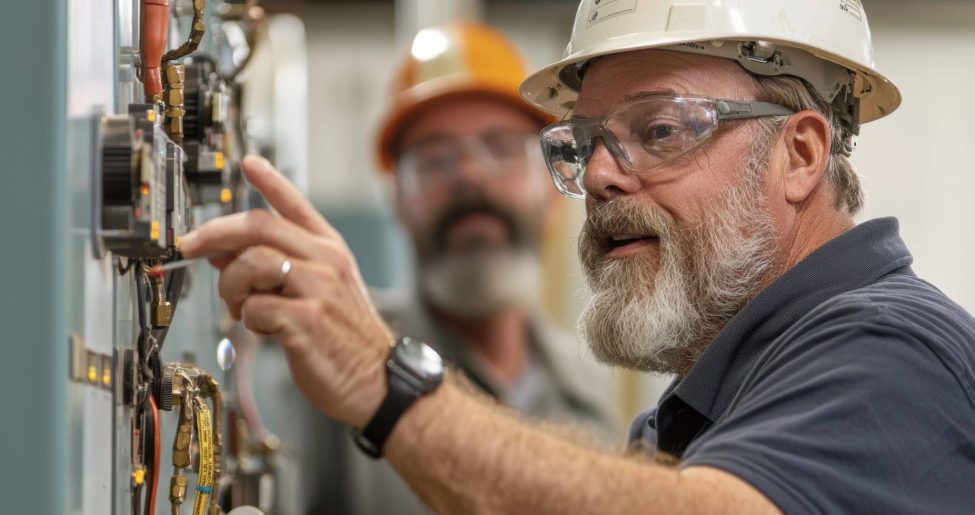
HVAC certifications and training improve technician performance, increase customer trust, and drive business growth by reducing callbacks, improving first-time fix rates, and ensuring compliance with industry standards. The most valuable certifications for HVAC companies include EPA Section 608 certification, the NATE certification, and manufacturer-specific training, all of which help technicians diagnose issues more accurately and deliver higher-quality service.
Finding qualified HVAC technicians has never been more challenging. At the same time, customer expectations continue to rise, equipment is becoming more sophisticated, and regulations are constantly evolving. For HVAC business owners, service managers, and contractors, investing in technician development has become more than simply filling knowledge gaps. It’s about improving performance, reducing costly mistakes, and creating a competitive advantage.
One of the most effective ways to achieve those goals is through strategic HVAC certification and ongoing training. But with so many credentials available, how do you know which certifications actually deliver measurable results?
The answer lies in focusing on certifications that directly improve technical competency, customer confidence, and business performance.
Why HVAC Certifications Matter
A well-trained technician can have a significant impact on an HVAC company’s profitability. Properly trained professionals diagnose problems faster, perform higher-quality installations, reduce callbacks, and create better customer experiences.
For business owners, that translates into:
- Fewer warranty claims and repeat visits
- Increased first-time fix rates
- Higher customer satisfaction
- Improved technician retention
- Greater revenue opportunities
- Loyal customers
The key is choosing certifications and training programs that align with your company’s services and long-term growth goals.
EPA Certification: The Essential Foundation
EPA certification for HVAC professionals working with refrigerants is not optional, it’s required.
The EPA Section 608 Certification demonstrates that technicians understand the proper handling, recovery, recycling, and disposal of refrigerants. Beyond regulatory compliance, it helps technicians work safely and responsibly while protecting customers and the environment. There are four types:
- Type I Certification: Covers servicing small appliances like household refrigerators, window air conditioners, and water coolers.
- Type II Certification: Covers servicing or disposing of equipment that uses high-pressure refrigerant, like residential air conditioners, heat pumps, and supermarket refrigeration.
- Type III Certification: Covers servicing or disposing of equipment that uses low-pressure refrigerant, like chillers.
- Universal Certification: Covers servicing or disposing of all equipment covered in types I, II, and III.
These certifications do not expire and will not need to be renewed.
NATE Certification: A Proven Performance Booster
North American Technician Excellence (NATE) certification validates a technician’s real-world knowledge and skills in installation and service. The group itself, NATE, is the largest nonprofit certification organization for heating, ventilation, air conditioning, and refrigeration (HVACR) technicians in the United States. Among industry credentials, NATE certification remains one of the most respected and recognized.
NATE offers several exam types:
- HVAC Support Technician Certificate: NATE recommends six months to one year of experience prior to earning this.
- CHP-5 and Traditional Pathway Certification Exams: NATE recommends two years of experience prior to earning these.
- Senior Level Efficiency Analyst Exam: NATE recommends five years of experience prior to earning this.
Technicians earning HVAC NATE certifications need to pass their Core Exam first. Then they can earn installation and/or service certifications in a variety of specialities, including:
- Heating: Gas furnaces, oil furnaces, hydronics (gas and oil)
- Cooling: Air conditioning, heat pumps
- Air Distribution: Duct sizing, airflow balancing, and system sizing
- Refrigeration: Light commercial refrigeration and commercial refrigeration
- Advanced Roles: Senior HVAC efficiency analyst
There are two distinct paths through which technicians earn their certifications:
- Traditional Pathway: The technician passes the Core Exam and at least one specialty exam.
- CHP-5 Pathway: The technician passes a series of five exams spanning foundational domains: HVAC Fundamentals, Electrical and Controls, Comfort and Airflow, Installation, and Service.
For customers, NATE-certified technicians provide reassurance that the person working on their system has demonstrated a high level of expertise.
For HVAC companies, the benefits are equally compelling. Technicians with NATE certification often:
- Diagnose issues more accurately
- Complete repairs more efficiently
- Reduce callbacks
- Increase customer trust
- Support higher close rates on recommendations and upgrades
In a competitive market, promoting a team of NATE-certified technicians can also serve as a powerful marketing differentiator.
Manufacturer Training: Where Theory Meets Application
While foundational certifications are important, manufacturer-specific training often delivers some of the most immediate operational benefits.
Modern HVAC systems continue to incorporate advanced controls, variable-speed technologies, communicating equipment, and higher-efficiency designs. Manufacturer training ensures technicians understand the unique features, installation requirements, and troubleshooting procedures associated with specific and evolving equipment lines.
When technicians receive training directly related to the products they install and service, companies often see:
- Faster installations
- Improved system performance
- Reduced warranty issues
- Better customer outcomes
- Increased technician confidence
For contractors and service teams, manufacturer training can help bridge the gap between textbook knowledge and real-world application.
Related: Why Professional Development Is Important for HVAC Professionals
Connecting Training to Business Results
Many business owners view training as an expense. However, the most successful companies view it as an investment, since the right HVAC certification path can improve measurable business outcomes (including higher service agreement conversions, increased average ticket values, stronger online reviews, and improved customer retention).
Customers notice when technicians communicate clearly, diagnose accurately, and solve problems efficiently. Those experiences build trust, and trust drives growth.
Partnering With Aireco for Ongoing Development
Building a high-performing HVAC team requires more than a one-time certification. It requires continuous learning and access to industry expertise.
Aireco supports HVAC contractors, service managers, installers, and technicians through training courses and events, technical resources, and equipment expertise designed to help professionals stay ahead of industry changes. Learn more about our ongoing training programs and how we can help build your business.
Whether your goal is developing entry-level technicians, expanding your team’s technical capabilities, or preparing for new technologies and regulations, ongoing education remains one of the smartest investments you can make.
Certifications help technicians perform better, help businesses operate more profitably, and help customers receive the level of service they expect. By focusing on certifications that truly move the needle, HVAC companies can create stronger teams, better customer experiences, and long-term growth.