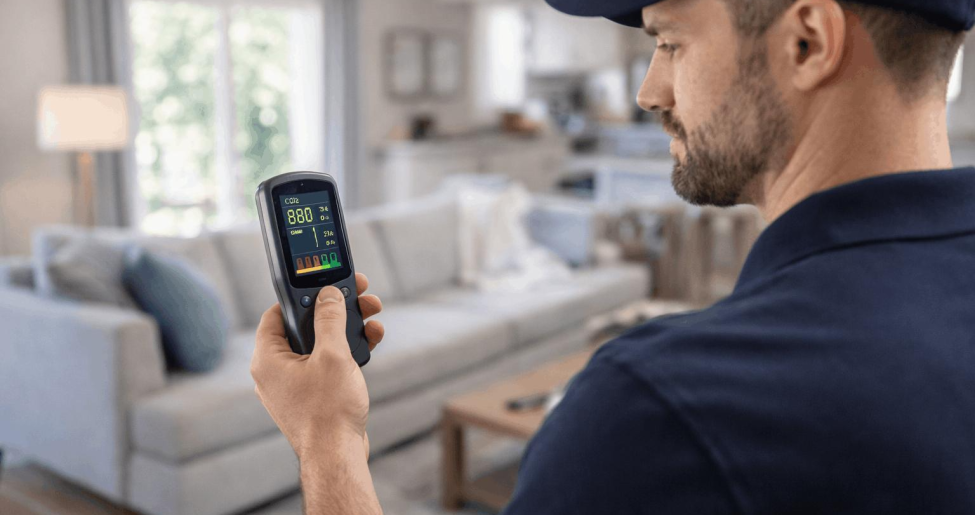
HVAC contractors can increase revenue and customer trust by making indoor air quality checks part of every service call. By using indoor air quality measurements to identify filtration, humidity, ventilation, and airflow issues, technicians can recommend appropriate indoor air quality solutions—from an upgraded AC filter to whole-home IAQ systems—while improving comfort, system performance, and average ticket size.
Every HVAC service call usually starts with a problem. But the problem the customer called about may not be the only one you can help solve.
Poor filtration, excess humidity, airborne particles, inadequate ventilation, and other indoor air quality (IAQ) concerns can affect comfort and HVAC performance. For contractors, that creates an opportunity to provide a more complete solution while increasing the value of each service call.
The key is to approach indoor air quality solutions as a diagnostic and service opportunity—not an upsell. Test first. Explain what you find. Then give customers appropriate options. Done well, IAQ can become a high-value addition to your service mix while building customer trust and increasing average ticket size.
Start With an Indoor Air Quality Check
You wouldn’t recommend replacing an HVAC system without diagnosing it first. Take the same approach to IAQ.
Build a basic indoor air quality check into your service process. Depending on the home and the equipment your team uses, that could include assessing:
- Existing filter type, condition, and fit
- Visible dust and particulate accumulation
- Indoor relative humidity
- Supply and return airflow
- Ventilation and fresh-air exchange
- Ductwork condition and leakage
- Signs of moisture around HVAC equipment
- Evidence of biological growth or excessive condensation
Technicians can also ask questions that provide useful context: Does the house feel unusually humid? Are some rooms stuffier than others? Does dust return quickly after cleaning? Are there pets, recent renovations, or other factors affecting the indoor environment?
The goal isn’t to manufacture a problem. It’s to uncover conditions the homeowner may already be noticing but hasn’t connected to the HVAC system.
Make Indoor Air Quality Measurements Part of the Conversation
Customers are more likely to understand an IAQ recommendation when they can see the reasoning behind it. Where appropriate, use instrumentation to gather indoor air quality measurements for factors such as relative humidity, particulate matter, carbon dioxide, or other relevant conditions. These indoor air quality metrics can give technicians objective information to discuss with homeowners.
Keep the explanation simple. Instead of overwhelming customers with readings and technical terminology, explain what the measurement means, why it matters, and what—if anything—you recommend doing about it.
That moves the conversation from “Here’s something else we can sell you” to “Here’s what we found, and here are your options.”
Look Beyond the Standard AC Filter
The AC filter is one of the simplest places to start an IAQ conversation, but it can also be one of the most misunderstood.
Many homeowners assume a higher MERV rating automatically means better filtration and therefore better air quality. Yet in reality, the filter needs to be appropriate for the system.
Higher-MERV filtration can capture smaller airborne particles, but it can also increase resistance to airflow. Before upgrading a filter, technicians should evaluate the equipment, duct system, filter cabinet, available surface area, and static pressure to make sure the system can accommodate it.
That expertise is valuable. Instead of simply selling a better filter, you’re helping the homeowner find the right balance between filtration and HVAC performance.
When a higher-efficiency filter isn’t enough—or isn’t appropriate for the existing system—other IAQ technologies may provide additional options.
Build IAQ Solutions Around the Customer
Indoor air quality isn’t one-size-fits-all, so avoid treating IAQ as a single product category.
A home with excessive humidity requires a different solution than one with inadequate ventilation. Depending on the diagnosis, recommendations might include:
- Higher-efficiency filtration
- Media air cleaners
- Humidification or dehumidification
- Fresh-air ventilation
- Air purification technologies
- Duct sealing or airflow improvements
- HVAC system maintenance
This is where technician education becomes especially important. Your team should understand not only how individual IAQ products work, but how they interact with the entire HVAC system.
The better your technicians can diagnose the underlying issue, the easier it becomes to recommend solutions confidently.
Bundle Solutions to Increase Value
Once you’ve identified an IAQ need, consider presenting complementary improvements as a package. For example, instead of quoting only an upgraded filter cabinet, you might offer good/better/best options that combine filtration with ventilation, humidity control, or another appropriate technology.
Bundling has advantages for both sides. The homeowner gets a clearer picture of what can be done and can choose an investment level that fits their priorities. Your business can complete multiple improvements during the same visit, reducing additional truck rolls while increasing average ticket size.
An HVAC service agreement can also be a natural part of the package. Ongoing maintenance provides opportunities to replace filters, inspect IAQ equipment, verify performance, and identify developing issues. That turns a one-time IAQ installation into a longer-term customer relationship.
Related: Boost Your HVAC Business with These Smart Marketing Strategies
Train Technicians to Educate, Not Sell
The strongest IAQ sales strategy may not feel like selling at all. Train technicians to follow a simple process: inspect, measure, explain, recommend.
Avoid fear-based claims about what’s “in the air” or promises that a particular product will solve every concern. Instead, give homeowners factual information and practical choices.
Technicians should be able to answer three questions clearly:
What did we find?
Why does it matter?
What can we do about it?
When customers understand the problem and trust the person explaining it, price often becomes only one part of the decision.
Related: Build Trust with HVAC Clients During In-Home Estimates
Make IAQ Part of Every Call
You don’t need to sell an IAQ product on every visit to make IAQ a valuable part of your business. You simply need to look on every visit.
Adding a consistent indoor air quality check to your service process can uncover legitimate opportunities, help technicians deliver more comprehensive service, and give customers another reason to rely on your company.
Aireco can help you build that capability with trusted HVACR and IAQ equipment, technical expertise, and ongoing education and training. Contact us today. From selecting the right products to helping your team understand how to apply them in the field, Aireco provides the resources HVACR professionals need to turn better indoor environments into better customer relationships—and stronger business.